London investors are running out of reasons to stay domestic. Stamp duty surcharges, mortgage interest restrictions, sluggish yields, and a stagnant residential market have pushed serious capital allocators to look beyond the UK.
Dubai property investment has become the most compelling alternative available to London-based investors right now. Rental yields of 8 to 12%, zero tax on income and gains, flexible payment plans, and a government-regulated market backed by one of the world’s most stable economies are drawing UK investors in record numbers.
This guide covers everything you need to know about why Dubai property investment works for UK investors, which areas deliver the strongest returns, how to structure your purchase correctly from a UK tax perspective, and how to get started without flying to the UAE.
Why Dubai Property Investment Makes Sense for London Investors in 2026

The case for Dubai property investment has never been stronger from a UK perspective. The combination of macro conditions, regulatory maturity, and return potential creates an environment that no domestic market can currently replicate for London investors.
Understanding the core drivers helps you invest with confidence rather than following a trend.
Rental Yields That UK Property Cannot Match
Dubai property investment consistently delivers gross rental yields of 8 to 12%, depending on the area and property type. According to the Dubai Land Department, residential transaction volumes hit record highs in 2024, reflecting the sustained demand that underpins these yield figures.
Compare this to London. Gross buy-to-let yields in London average between 3.5 and 5% across most boroughs. After stamp duty surcharges, mortgage interest restrictions, and letting agent fees, net returns rarely exceed 3% for most London landlords.
Dubai property, even after factoring in management fees and UK tax obligations, still outperforms London buy-to-let on a net basis for the majority of investor profiles.
A Zero Tax Environment That Changes the Numbers
The UAE charges no personal income tax and no capital gains tax. Every dirham your Dubai property investment generates in rental income belongs entirely to you at the UAE level.
UK residents still declare overseas rental income to HMRC. However, the absence of UAE-side taxation dramatically improves net returns compared to any UK rental investment where income is taxed at source.
For a London investor paying 40% income tax on domestic rental profits, the shift to a zero-tax environment on the UAE side creates a material and immediate improvement in net yield performance.
Political Stability and a Government-Backed Market
Dubai property investment benefits from one of the most stable political environments in the Middle East. The UAE federal government has consistently backed the real estate sector with structural reforms, investor protections, and infrastructure investment over two decades.
The Real Estate Regulatory Authority (RERA) oversees all developer licensing, project registration, and buyer fund protection. Mandatory escrow requirements ensure off-plan buyer payments are held securely until verified construction milestones are reached.
This regulatory framework gives Dubai property investment a level of institutional credibility that many alternative overseas markets simply cannot offer.
Key reasons London investors are choosing Dubai property investment in 2026:
- Gross rental yields averaging 8 to 12% versus 3.5 to 5% in London
- Zero UAE tax on rental income and capital gains
- 40%+ capital appreciation recorded in prime areas since 2020
- RERA-regulated market with mandatory developer escrow protection
- UAE Golden Visa eligibility for investments above AED 2 million
- Flexible off-plan payment plans with 0% interest structures
- Entry points from £125,000 with staged payment options
The fundamentals driving Dubai investment are structural, not cyclical. Population growth, government investment, and international wealth migration are long-term forces that support sustained demand.
Best Areas for Dubai Property Investment in 2026

Location is the single most important variable in any Dubai property investment decision. Different areas serve different investment objectives. Understanding which area aligns with your goals prevents costly mismatches between expectations and outcomes.
The Dubai property market covers over 60 designated freehold zones open to foreign buyers. These are the areas delivering the strongest results for London investors right now.
Dubai Marina and Downtown Dubai
Dubai Marina is the benchmark area for yield-focused Dubai property investment. Gross yields on well-located Marina apartments consistently range from 7 to 9%. Deep rental demand from professional expatriates and a highly active secondary market make Marina one of the most liquid areas for both entry and exit.
Downtown Dubai sits at the premium end of the Dubai property investment spectrum. Properties here command the highest per-square-foot prices in the city and have delivered over 40% capital appreciation since 2020 in several buildings, according to Knight Frank’s Global Residential Cities Index. This is primarily a capital growth play for London investors with higher budgets.
Entry points in Dubai Marina start from approximately £175,000 for a well-located one-bedroom apartment. Downtown entry begins from approximately £250,000 for comparable units.
Dubai Hills Estate and Business Bay
Dubai Hills Estate has emerged as one of the most consistently in-demand communities for Dubai property investment over the past three years. Developed by Emaar, it combines green space, family amenities, and strong school access to drive sustained long-term occupancy.
Gross yields on Dubai Hills apartments typically range from 6 to 8%. Townhouses and villas offer stronger capital appreciation. For London investors wanting a balanced yield and growth profile, Dubai Hills is one of the most compelling options in the current market.
Business Bay offers slightly more accessible entry prices than Downtown while sharing the same central location advantage. Strong demand from business professionals and ongoing commercial development make Business Bay a reliable Dubai property investment zone for yield-focused buyers.
Jumeirah Village Circle and Dubai South
Jumeirah Village Circle is the go-to area for yield-maximizing Dubai property investment on a tighter budget. Entry prices are significantly lower than Marina or Downtown, while gross yields of 8 to 10% are commonly achievable in well-managed buildings.
Dubai South is the long-term growth play. The planned expansion of Al Maktoum International Airport into one of the world’s largest aviation hubs is expected to drive significant residential demand across this corridor over the next decade. According to the Dubai Statistics Center, Dubai’s population grew from 3.3 million in 2020 to over 3.8 million by the end of 2024, with the Dubai Urban Master Plan 2040 targeting 5.8 million residents. Dubai South is directly positioned to absorb a substantial portion of that growth.
Choosing the right area for your Dubai property investment:
- Yield-first strategy: Jumeirah Village Circle or Dubai Marina
- Capital growth strategy: Downtown Dubai or Palm Jumeirah
- Balanced yield and growth: Dubai Hills Estate or Business Bay
- Long-term emerging corridor: Dubai South and Expo City
- Golden Visa qualifying investment: Any freehold area above the AED 2 million threshold
Area selection shapes everything from your rental income to your resale timeline. Your advisor at the Dubai Property Show London will match you to the right location based on your specific investment goals.
How to Structure Your Dubai Property Investment From the UK

Structure is the most overlooked part of Dubai property investment for London investors. The right ownership structure can meaningfully reduce your UK tax liability, improve your ability to scale, and protect your returns over the long term.
Get this decision right before you sign anything. Unwinding the wrong structure after purchase is expensive and disruptive.
Personal Ownership
Personal ownership is the simplest route into Dubai investment. You purchase in your own name, the title deed is registered with the Dubai Land Department under your personal details, and all rental income flows directly to you.
This works well for first-time Dubai investors at the lower budget range. The administration is minimal, and UAE financing options through local banks are straightforward for personal buyers.
The main limitation is tax efficiency. Rental income from your Dubai property investment is added to your existing UK income and taxed at your marginal rate. For higher-rate taxpayers in London, this means 40 to 45% of net rental profits go to HMRC.
UK Limited Company
Purchasing Dubai property investment through a UK-registered limited company is increasingly the preferred route for London investors earning above the higher-rate tax threshold.
Corporation tax at 25% for profits above £250,000 represents a significant saving compared to personal income tax rates of 40 to 45%. Profits retained inside the company can be reinvested without triggering immediate personal tax. Salary and dividend combinations allow tax-efficient income extraction over time.
The Ltd company structure also makes scaling a multi-property Dubai portfolio considerably more manageable from an administrative and tax planning perspective.
For a full breakdown of ownership structures and financial considerations, read our detailed guide on buying property in Dubai from the UK.
Tax Obligations to HMRC
Dubai property investment creates specific and non-negotiable HMRC obligations. All overseas rental income must be declared on your UK self-assessment tax return, regardless of whether the income sits in a UAE bank account.
Allowable deductions against your Dubai rental profits include management fees, service charges, maintenance costs, and professional fees. A well-structured expense position reduces your taxable profit considerably below your gross rental income.
HMRC’s overseas property income guidance sets out the full reporting framework. Working with a UK accountant who specializes in overseas property income is strongly recommended for any London investor pursuing Dubai property investment.
HMRC checklist for UK investors in property investment:
- Declare all Dubai rental income annually on your self-assessment return
- Deduct all allowable expenses before calculating taxable profit
- Report any capital gain on sale above your annual CGT allowance
- Consider a Ltd company structure if you are a higher-rate or additional-rate taxpayer
- Consult a UK international tax advisor before finalizing your ownership structure
Understanding your UK obligations fully before you invest removes the most common source of post-purchase stress for London buyers in the Dubai property investment market.
Off-Plan vs Ready Properties: Which Is Right for Your Dubai Investment?
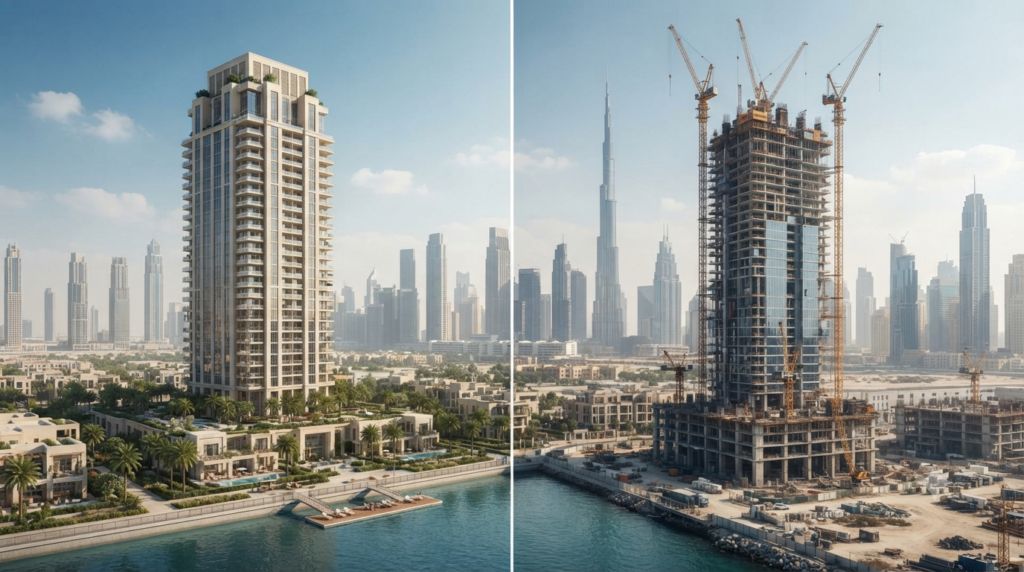
One of the most important decisions in any Dubai property investment journey is choosing between off-plan and ready properties. Both deliver strong returns. But they serve different investor profiles and timelines.
Understanding the distinction upfront allows you to match your Dubai property investment to your actual financial situation and goals.
The Case for Off-Plan Dubai Property Investment
Off-plan investment means purchasing before or during construction. You pay a reservation deposit, sign a Sales Purchase Agreement with a RERA-licensed developer, and follow a staged payment schedule tied to construction milestones.
The advantages are significant. Off-plan properties are typically priced below their completed market value. Capital appreciation between purchase and completion is common in well-located projects. Post-handover payment plans allow you to defer a portion of the purchase price until after the property is built and generating rental income.
For London investors with a 2 to 4 year horizon and a preference for lower upfront capital deployment, off-plan Dubai property investment offers the most financially efficient entry point available.
The Case for Ready Properties
Ready Dubai property means buying a completed asset. Rental income starts from the point of purchase rather than from completion. There is no construction risk, no wait time, and no uncertainty about the finished product.
The trade-off is price. Ready properties are priced at the current market value without the below-market entry advantage of off-plan. Full payment is typically required at transfer rather than in staged installments.
For London investors who want immediate cash flow, or who are risk-averse about construction timelines, ready Dubai property investment is the more appropriate route. Established areas like Dubai Marina and Business Bay have deep, ready property markets with strong secondary liquidity.
Payment Plan Structures Explained
Off-plan Dubai property investment payment plans follow several common structures. Understanding them helps you budget accurately before committing.
Construction-linked plans tie your payments to verified build milestones such as foundation, superstructure, and fit-out. Typically, 60 to 70% is paid during construction with the balance due at handover.
Post-handover plans defer 30 to 40% of the purchase price until after completion. Payments are spread over 1 to 3 years post-handover, allowing rental income to fund a substantial portion of the remaining installments.
For a full walkthrough of the purchase process from reservation to title deed, read our complete guide on how to buy property in Dubai.
Off-plan vs ready Dubai property investment: quick comparison:
- Entry price: Off-plan lower, ready at current market value
- Income timing: Off-plan from completion, ready from purchase
- Capital growth potential: Off-plan, stronger pre-completion, ready, more stable
- Payment flexibility: Off-plan staged plans, typically ready with full payment at transfer
- Construction risk: Off-plan present, ready none
- Best for: Off-plan suits growth-focused investors, ready suits yield-first buyers
Both routes are well represented at the Dubai Property Show London. Your advisor will help you identify which structure best matches your timeline and budget.
What Returns Can UK Investors Expect From Dubai Property Investment?
Return expectations should be grounded in real data rather than marketing projections. Here is an honest picture of what property investment delivers for London investors based on current market performance.
This section draws on verified third-party sources so you can assess the numbers independently.
Rental Yield Performance by Area
Rental yield is the most immediate return metric for Dubai property investment. Here is a breakdown of current gross yield ranges by area, based on Dubai Land Department transaction data and Knight Frank research.
Jumeirah Village Circle consistently delivers gross yields of 8 to 10% on well-located apartments. Dubai Marina produces 7 to 9% on residential units. Business Bay and Downtown Dubai range from 6 to 8%, depending on unit size and building quality. Dubai Hills Estate apartments yield 6 to 8%, with townhouses slightly lower but with stronger appreciation potential.
After property management fees of 5 to 8% of annual rental income, net yields of 6 to 9% are achievable in the strongest performing areas. This remains significantly ahead of London net buy-to-let yields even before factoring in the zero UAE tax advantage.
Capital Appreciation Track Record
Capital appreciation has been a major driver of total return for Dubai property investment since 2020. According to Knight Frank, prime Dubai residential prices rose by over 16% in 2024 alone, with several key areas delivering cumulative gains above 40% since 2020.
This appreciation has been driven by genuine population growth and supply constraints rather than speculative activity. Dubai’s population increased by over 500,000 residents between 2020 and 2024, according to the Dubai Statistics Center, creating sustained housing demand that has consistently outpaced new delivery in prime areas.
Total Return Compared to UK Buy-to-Let
A side-by-side comparison illustrates the Dubai property investment advantage clearly. A £200,000 London buy-to-let property generating 4% gross yield produces £8,000 in annual rental income before costs. After mortgage interest restrictions, management fees, and 40% income tax on net profits, the real annual return for a higher-rate taxpayer is often below £3,000.
A comparable £200,000 Dubai property investment generating 9% gross yield produces £18,000 in annual rental income. After management fees and UK income tax on net profits, a higher-rate taxpayer typically retains £8,000 to £10,000 annually. This is 3 to 4 times the net return on a comparable UK investment, without the stamp duty surcharge burden at entry.
For more context on the current market driving these returns, read our full Dubai property market 2026 briefing.
Summary of expected returns from property investment:
- Gross rental yield: 8 to 12%, depending on area and property type
- Net rental yield after management fees: 6 to 9%
- Capital appreciation in prime areas since 2020: up to 40%+
- Entry-level transaction costs: approximately 5 to 6% of the purchase price
- UAE tax on rental income: zero
- UK income tax on net rental profit: at your marginal rate
Returns are strong, well-documented, and supported by structural demand fundamentals that show no sign of reversing in the near term.
Frequently Asked Questions
Is Dubai property investment safe for UK investors?
Yes, when conducted through RERA-licensed developers in designated freehold zones. The Dubai Land Department registers all transactions and issues legally binding title deeds. Mandatory escrow protections ensure off-plan buyer funds are secure throughout the construction process. For a full risk breakdown, read our guide on buying property in Dubai.
How much do I need to start a Dubai property investment from the UK?
Entry-level properties in Dubai start from approximately £125,000. Off-plan payment plans typically require only 10 to 20% upfront, meaning you can secure a Dubai property investment with an initial outlay of £12,500 to £25,000 in many cases. For more details on the process, read our guide on buying property in Dubai from the UK.
Can Dubai property investment qualify me for UAE residency?
Yes. Purchasing an eligible property above AED 2 million (approximately £430,000) qualifies you for a 10-year UAE Golden Visa. This grants residency rights for you and your immediate family without any requirement to relocate. Read our full guide on how to buy property in Dubai and get UAE residency.
Do I pay tax in the UK on Dubai property investment income?
The UAE charges zero tax on rental income and capital gains. However, UK residents must declare all overseas rental income to HMRC on their annual self-assessment return. Your Dubai rental profits are taxed at your UK marginal income tax rate. Allowable deductions reduce your taxable profit considerably below gross rental income.
How do I get started with Dubai property from London?
The fastest and most direct route is attending the Dubai Property Show London 2026. You can meet RERA-licensed developers, explore over 100 verified projects from £125,000, and receive one-on-one advice from UK-to-Dubai investment specialists. Find out exactly what to expect at the Dubai property show in London before you register.
Ready to Start Your Dubai Property Investment From London?
Dubai property investment in 2026 offers London investors a combination of yield, growth, tax efficiency, and structural demand that no UK alternative can match. The regulatory framework is solid, the returns are verified, and the entry process is more straightforward than most investors expect.
Whether you are looking for immediate rental income, long-term capital appreciation, UAE Golden Visa eligibility, or simply a way to diversify beyond a stagnant UK property market, Dubai property delivers on every objective.
The Dubai Property Show London is your most direct route to getting started. Meet verified developers, explore 100+ curated projects from £125,000, and walk away with a personalized Dubai property investment plan built around your goals.
Register your free place today at dubaipropertyexpolondon. co. uk.
For more on the full process, read our complete guide on ” Can you buy property in Dubai as a UK citizen and our step-by-step ” How to buy property in Dubai guide.