Quick Answer
- Dubai’s average property price sits around AED 2.9 million (roughly £586,000 / $795,000), with prices per square foot averaging AED 1,923.
- Nearly 199,800 property transactions were recorded recently, up 6.29% on the previous period, confirming steady market momentum.
- Rental yields in Dubai range from 5.6% to 6.3%, among the highest of any major global city.
- Entry-level off-plan studios start from around AED 550,000, while luxury villas on Palm Jebel Ali can exceed AED 30 million.
- Buying property worth AED 2 million or more (mortgage-free or 50%+ paid off) qualifies foreign buyers for the UAE’s 10-Year Golden Visa.
Dubai’s skyline isn’t just a tourist backdrop anymore; it’s become one of the most active property markets in the world.
Whether you’re an overseas investor chasing rental yield, an expat ready to stop renting, or a first-time buyer comparing options, the sheer number of listings for properties for sale in Dubai can feel overwhelming.
This guide breaks the market down into what actually matters: prices, areas, property types, off-plan versus ready stock, the legal buying process, and the numbers that decide whether a deal is worth it.
Dubai Property Market Snapshot
Before comparing neighborhoods or property types, it helps to understand the market you’re stepping into. Dubai’s real estate sector has spent the last few years shifting from a boom-and-bust reputation toward something steadier, and the transaction and pricing data below explain why so many buyers now treat it as a long-term hold rather than a short-term flip.
Market Growth Numbers
Dubai real estate has kept expanding rather than cooling off. The latest figures from Property Finder’s Dubai listings put total Dubai Land Department transactions at close to 199,800, a jump of 6.29% from the prior reporting period, with rental yields holding at a strong 5.6% average across the emirate. That combination of rising transaction volume plus resilient yields is why so many buyers treat Dubai as a serious income-generating asset rather than a purely lifestyle purchase.
For anyone comparing this cycle to previous ones, the takeaway is simple: demand hasn’t just held up, it has broadened. Browsing dubizzle’s residential listings for sale shows freehold ownership now spans more than 23 neighborhoods across the city, giving both residents and overseas buyers far more entry points than a decade ago. That broader footprint is exactly what’s driving the price movement covered next.
Property Price Trends
The average property price across Dubai currently sits near AED 2.9 million (about AED 1,923 per square foot), while budget-conscious buyers can still find off-plan studios in Dubai South from roughly AED 550,000, based on current figures pulled from Property Finder’s buy section. At the top end, villas on Palm Jebel Ali regularly clear AED 30 million, showing just how wide the price spectrum stretches from entry-level to ultra-luxury.
| Segment | Typical Starting Price (AED) | Example Location |
| Off-plan studio | 550,000 | Dubai South |
| Mid-range apartment | 1,000,000–1,800,000 | JVC, Business Bay |
| Family villa/townhouse | 2,000,000–5,000,000 | Dubai Hills, Arabian Ranches |
| Ultra-luxury villa | 30,000,000+ | Palm Jebel Ali |
Prices vary this much because location, developer, and payment plan all move the number independently, which is exactly why picking the right area matters more than chasing the lowest listed price.
Once you have a price range in mind, the next decision is almost always location. Dubai’s neighborhoods each carry a different mix of lifestyle, yield potential, and buyer profile, so the next section breaks down the three clusters that come up most often in buyer searches.
Best Dubai Areas To Buy
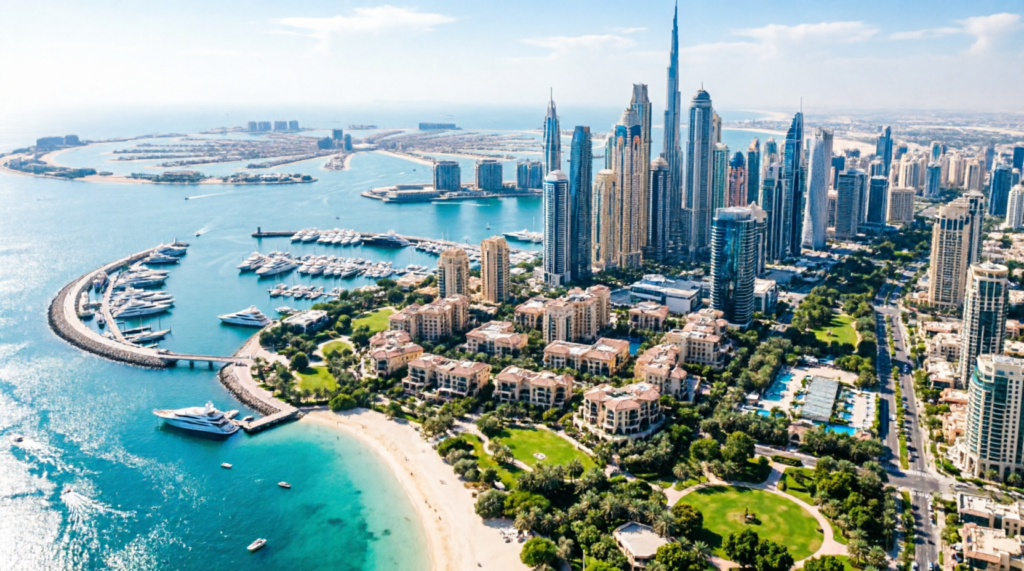
Location drives everything else in this market: resale value, rental demand, even mortgage approval in some cases. Rather than listing every community, it’s more useful to group Dubai’s most searched areas into three practical buckets: ultra-luxury beachfront, high-yield rental hubs, and central urban addresses.
Palm Jumeirah
Palm Jumeirah remains Dubai’s flagship address for beachfront villas and branded residences. A scan of Rightmove’s Palm Jumeirah listings shows it’s consistently home to some of the highest-value properties in the city, including private-island mansions and Bulgari-branded residences.
It’s the benchmark most other waterfront developments in Dubai get compared against. If ultra-luxury and instant brand recognition matter to your investment thesis, Palm Jumeirah is usually the first stop, but its premium pricing means it’s rarely the best fit for a first Dubai purchase.
Dubai Marina & JBR
Dubai Marina and neighboring Jumeirah Beach Residence offer high-rise apartments with direct promenade and beach access. According to Provident Estate’s property listings, these areas remain magnets for professionals and investors chasing strong rental returns thanks to walkable dining, retail, and transport links.
This is where a lot of buy-to-let demand concentrates, since tenants are willing to pay a premium for the lifestyle. For investors specifically prioritizing rental income over long-term capital appreciation, this cluster of areas usually delivers the most predictable occupancy.
Downtown Dubai & Business Bay
Downtown Dubai, home to the Burj Khalifa and The Dubai Mall, delivers the city’s most central, upscale urban experience, while Business Bay next door has become one of the most active zones for new tower launches along Sheikh Zayed Road. Provident Estate’s area guide notes both suit buyers who want walkability and proximity to Dubai’s commercial core.
Buyers weighing Downtown against Business Bay should treat it as a trade-off between prestige (Downtown) and value-for-money new stock (Business Bay) rather than assuming one is objectively better.
With location narrowed down, the next question buyers usually ask is what kind of property actually fits their budget and lifestyle inside that area: apartment, villa, or somewhere in between.
Types Of Dubai Properties
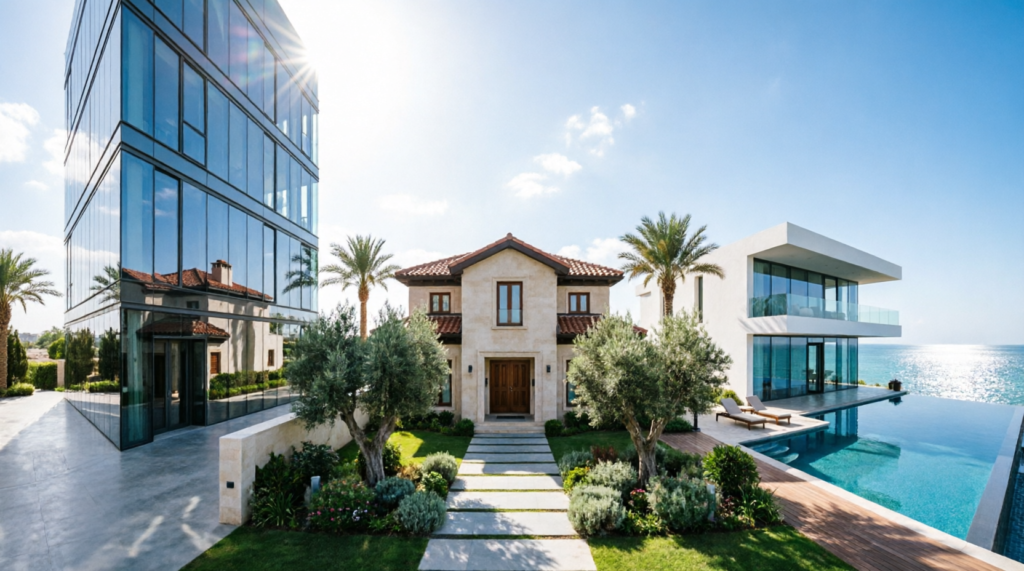
Dubai’s inventory spans everything from a 335 sq ft studio to a multi-floor beachfront estate, so matching property type to purpose matters as much as matching location. Broadly, the choice comes down to apartments and penthouses versus villas and townhouses.
Apartments & Penthouses
Apartments dominate Dubai’s for-sale listings, ranging from compact studios of around 335–485 sq ft up to sprawling multi-bedroom penthouses with panoramic skyline or waterfront views. Both Property Finder’s Dubai buy pages and Provident Estate’s listings confirm high-rise towers in Downtown Dubai, Dubai Marina, and Business Bay typically bundle in pools, gyms, and concierge access as standard.
This segment is usually the easiest entry point for first-time or overseas buyers, since studio and one-bedroom units carry the lowest price tags in the market.
Villas & Townhouses
Villas suit buyers who want private gardens, pools, and more separation from neighbors, with prime clusters in Palm Jumeirah, Emirates Hills, and Arabian Ranches. Provident Estate’s community breakdown also highlights townhouses in Dubai Hills Estate, DAMAC Lagoons, and The Springs as a middle ground between space and shared-community convenience.
Families weighing this category should treat townhouses as the practical compromise: less land than a villa, but meaningfully more room and privacy than an apartment for a similar budget.
Property type is only half the picture, though. In Dubai, almost every listing also falls into one of two construction stages: off-plan or ready, and that distinction changes the risk, price, and payment structure of the whole deal.
Off-Plan Vs Ready Properties
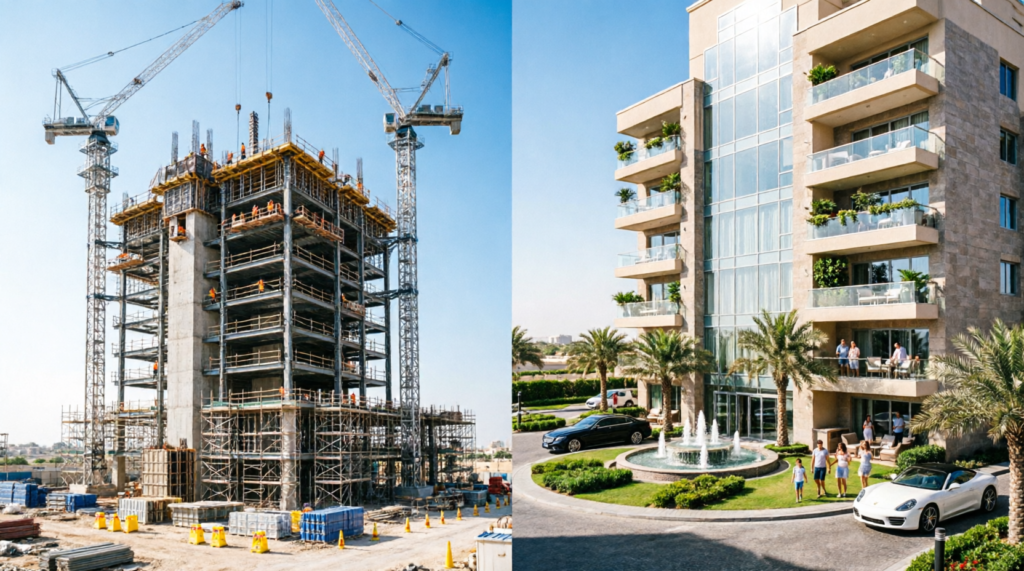
Dubai’s market runs on two parallel tracks: units still under construction and units ready to move into today. Both show up constantly in search results for properties for sale in Dubai, so it’s worth understanding what separates them before you commit to either.
Off-Plan Advantages
Off-plan property units purchased directly from a developer before or during construction typically come with lower entry prices and extended, developer-backed payment plans, which is why so many of the newer listings on Rightmove’s Dubai overseas property section advertise staged plans like 20% down with the balance spread through handover and beyond. Some developments even offer post-handover payment schedules stretching two or more years.
This structure is attractive for investors who want to spread out their capital outlay, but it does mean tying up money in a project that won’t generate rental income until it’s actually built and handed over.
Ready Property Benefits
Ready properties, by contrast, let a buyer move in or start renting immediately, with no construction risk and no waiting on a developer’s delivery timeline. Rightmove’s Dubai listings show a wide mix of ready apartments and villas already generating rental income for their current owners, which is part of why ready stock in established communities tends to hold its resale value more predictably than off-plan units in unproven locations.
For buyers who want certainty over discount, ready properties are generally the safer route, even if the upfront price is higher than a comparable off-plan unit.
Once you’ve decided between off-plan and ready, the practical part of the journey starts: working through the legal steps, financing, and fees that actually get a property into your name.
How To Buy Property In Dubai

Buying in Dubai follows a structured, government-backed process, which is one of the reasons the market has become comfortable for international buyers with no UAE residency. It generally breaks down into three stages: the legal paperwork, financing, and the fees that come with both.
Legal Buying Steps
Once a price is agreed, the buyer and seller sign a Memorandum of Understanding, known as Form F, which gets registered with RERA before the deal moves to final transfer. Guidance from Property Finder’s buying process overview explains that applicable fees the DLD fee, agency commission, and mortgage registration where relevant are settled at this final stage. Betterhomes’ buying guide adds that after the Sale Agreement is signed and the deposit paid, registration completes at the Dubai Land Department, which issues the title deed.
Because this process runs through official government channels rather than informal contracts, buyers get a level of legal certainty that’s uncommon in many other overseas property markets.
Mortgage Financing
Both residents and non-residents can apply for a Dubai mortgage, though Property Finder’s mortgage section notes non-residents generally face higher down payments and a smaller pool of lenders. Options typically include fixed-rate mortgages for the first one to five years, variable-rate mortgages that track the market, and a smaller set of off-plan mortgage products for properties still under construction.
Whichever route you take, it’s worth comparing at least three lenders before committing, since down-payment requirements for non-residents can vary significantly between banks.
Fees And Costs
Beyond the sale price itself, buyers should budget for the Dubai Land Department transfer fee, agency commission, and, for financed purchases, a mortgage registration fee, all of which are typically settled during the final transfer stage described in Property Finder’s transaction guide. These costs generally add a few percentage points on top of the purchase price, so they should be part of the initial budget rather than a surprise at closing.
Planning for these costs upfront avoids the common mistake of maxing out a budget on the property price alone and then scrambling to cover transfer and registration fees at the last minute.
With the buying process mapped out, the last piece of the puzzle is understanding what the investment actually returns, both in rental income and in residency benefits.
Investment Returns And Visas
For many buyers, the real question isn’t whether they can buy in Dubai; it’s whether the numbers justify it. Two figures matter most here: rental yield and Golden Visa eligibility.
Rental Yield Data
Dubai’s rental yields average around 5.6%, with Betterhomes’ market overview citing figures as high as 6.3% depending on the area and property type, well above what most investors see in London, New York, or Singapore. Waterfront and centrally located units tend to sit at the higher end of that range because tenant demand is strongest there.
For buy-to-let investors, this yield gap versus other global cities is usually the single biggest reason Dubai makes the shortlist in the first place.
Golden Visa Rules
Foreign buyers who purchase a completed, mortgage-free property worth AED 2 million or more or one that’s at least 50% paid off can qualify for the UAE’s 10-Year Golden Visa, according to Property Finder’s visa eligibility notes. It’s one of the few residency-by-investment routes tied directly to real estate rather than a separate government fund.
Anyone treating a Dubai purchase as a residency strategy, not just an investment, should confirm the AED 2 million threshold and payment status with a licensed conveyancer before signing, since the rules are specific about what counts as “paid off.”
Recommended Resources
| Link Type | Anchor Text | Destination |
| External | Property Finder Dubai listings | propertyfinder.ae/buy/dubai |
| External | Rightmove overseas Dubai listings | rightmove.co.uk/overseas-property-for-sale/Dubai |
| External | Audleys International buying guides | audleysinternational.com/guides |
| External | Dubai property types and pricing | providentestate.com/buy |
| External | UAE mortgage and buying process | bhomes.com/en/buy |
| Internal | Dubai mortgage guide (link to your own mortgage/finance page) | /dubai-mortgage-guide |
| Internal | Off-plan vs ready properties (link to your own comparison page) | /off-plan-vs-ready-dubai |
| Internal | Best areas to invest in Dubai (link to your own neighborhoods page) | /best-areas-invest-dubai |
Whether you are comparing communities or planning your purchase, the resources below can help you take the next step with confidence.
Is Dubai Property Still Worth Buying in 2026?
Dubai’s property market has moved well past its old reputation as a boom-and-bust playground. The current numbers nearly 200,000 transactions, 5.6%+ rental yields, and price growth across both off-plan and ready segments point to a market that’s maturing rather than overheating. Buyers today have more freehold neighborhoods, more financing options, and clearer legal protections through RERA than at almost any point in the market’s history.
That said, none of this removes the need for due diligence. Prices swing dramatically between a Dubai South studio and a Palm Jebel Ali villa, mortgage terms differ sharply for non-residents, and Golden Visa eligibility hinges on specific payment conditions. The right property for an investor chasing yield in Dubai Marina looks nothing like the right property for a family wanting a villa in Arabian Ranches, so matching the property type and whether it’s off-plan or ready to your actual goal matters more than chasing the lowest advertised price.
If you’re ready to move from research to action, the next step is narrowing your shortlist to two or three areas that match your budget and purpose, then get in touch with Dubai Property Expo London, a licensed Dubai agent, to book viewings before the best-priced units in your range are gone.
Frequently Asked Questions
Is it a good time to buy property in Dubai in 2026?
Yes. Transaction volume is up 6.29%, and rental yields remain above 5.6%, reflecting steady demand rather than speculative growth. However, the best time to buy depends on your budget, investment goals, and whether you choose an off-plan or ready property.
Can foreigners buy property in Dubai?
Yes. Foreigners can purchase freehold property in more than 23 designated areas across Dubai with full ownership rights. Both residents and non-residents can also apply for mortgages through eligible UAE banks, subject to lender requirements.
How much do I need to buy a property in Dubai?
Entry-level off-plan studios start from around AED 550,000, making Dubai accessible to a wide range of investors. Buyers should also budget for the 4% DLD registration fee, agency commission, and any required down payment or financing costs.
What is the minimum property value for a UAE Golden Visa?
A completed, mortgage-free property worth AED 2 million or more, or one with at least 50% of the mortgage paid, qualifies for the 10-year UAE Golden Visa. This visa also allows eligible investors to sponsor their spouse, children, and other qualifying family members.
Which area in Dubai has the best rental yield?
Rental yields vary by community, but JVC, Dubai Marina, and Business Bay consistently rank among the strongest-performing areas. Depending on the property type and location, investors can typically expect gross yields between 5.6% and 6.3%, with some communities delivering even higher returns.