






London investors who have done their research on Dubai already know the numbers are compelling. Rental yields of 8 to 12%, zero tax on income and gains, flexible payment plans, and a regulated property market backed by one of the world’s most stable governments.
What many still want is a single, clear, end-to-end answer to the most practical question of all. How to buy property in Dubai as a UK investor, from first research to title deed in hand, without gaps, ambiguity, or expensive mistakes along the way.
This is the guide. Every step of the process is laid out in sequence, with the costs, the legal requirements, the UK tax obligations, and the practical shortcuts that experienced investors use to make the journey faster and simpler.
Step 1: Define Your Investment Objective

Before anything else, get clear on what you are buying for. This single decision shapes every subsequent choice, from location to property type to ownership structure.
The four primary investment objectives London investors bring to the Dubai market are:
Rental yield: Maximum cash flow from day one or shortly after handover. Best served by high-demand residential areas like Dubai Marina, Jumeirah Village Circle, and Business Bay, with properties in buildings that have strong tenancy track records.
Capital appreciation: Long-term asset growth with lower initial yield. Best served by prime central areas like Downtown Dubai and Palm Jumeirah, or emerging growth corridors like Dubai South, where infrastructure investment is driving future demand.
UAE Golden Visa: Residency rights through property ownership. Requires a minimum purchase value of AED 2 million (approximately £430,000). Best served by prime freehold properties that also deliver strong yield or appreciation alongside the residency benefit.
Portfolio diversification: Reducing concentration in UK assets and GBP-denominated investments. Any well-located Dubai freehold property in a RERA-regulated development serves this objective, regardless of area.
Most London investors are targeting a combination of yield and diversification, with Golden Visa eligibility an increasingly common secondary goal. Be clear on your priority before you arrive at the Dubai Property Show London, as it determines which developers and projects are most relevant to you.
Step 2: Set Your Budget and Understand Your Entry Point
Dubai property is accessible at a wider range of budget levels than most London investors expect. Here is a realistic breakdown of what different budget levels unlock in the current market.
From £125,000
Studio and one-bedroom apartments in well-located communities, including Jumeirah Village Circle, Dubai South, and selected Business Bay buildings. Off-plan payment plans at this level typically require 10 to 20% upfront, meaning you can enter with as little as £12,500 to £25,000 as an initial reservation payment.
From £200,000 to £350,000
One and two-bedroom apartments in Dubai Marina, Downtown Dubai, and Dubai Hills Estate. This range opens access to the most liquid areas of the market with the strongest rental demand from professional expatriate tenants.
From £430,000 and above
Golden Visa qualifying properties. Premium apartments, townhouses, and entry-level villas in prime freehold zones. At this level, you unlock UAE residency rights alongside the investment return.
Above £700,000
Luxury villas, full floors, and premium waterfront apartments in Palm Jumeirah, Emaar Beachfront, and Downtown. Ultra-high-net-worth London investors at this level are typically targeting capital preservation, appreciation, and lifestyle value alongside financial returns.
Your budget also needs to account for transaction costs of approximately 5 to 6% of the purchase price on top of the property value. The highest single cost is the Dubai Land Department registration fee of 4%.
Step 3: Choose Between Off-Plan and Ready Properties
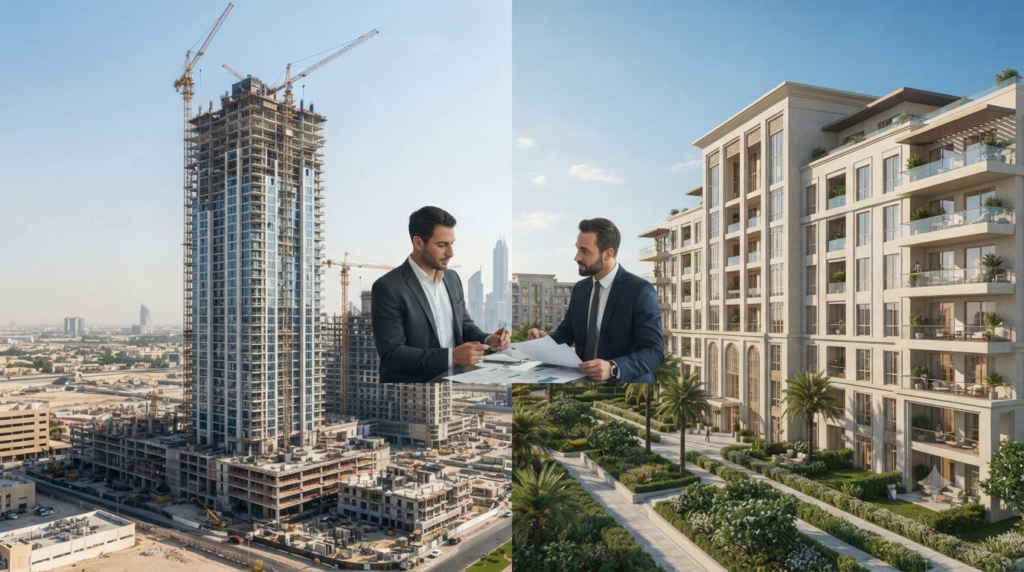
This is one of the most important structural decisions in how to buy property in Dubai as a UK investor. Both routes have clear advantages.
Off-Plan Properties
Off-plan means you are buying a property before or during its construction phase. You sign a Sales Purchase Agreement with the developer, pay a reservation deposit, and then follow a staged payment schedule tied to construction milestones.
The advantages for London investors are significant. Off-plan properties are priced below their completed market value in most cases. Payment is spread over the construction period and sometimes beyond, through post-handover payment plans. Capital appreciation between purchase and completion is common in well-located projects.
The risk is developer delivery. Always buy off-plan from a RERA-licensed developer with a verified completion track record. Every developer at the Dubai Property Show London meets this standard.
Ready Properties
Ready properties are completed and available for immediate occupation or tenancy. They generate rental income from the point of purchase rather than from completion. There is no construction risk and no wait time.
The trade-off is price. Ready properties are priced at current market value, without the below-market entry advantage that off-plan offers. Payment is also typically required in full at the point of transfer rather than in staged instalments.
For London investors who want immediate cash flow or who are risk-averse about construction timelines, ready properties are the more appropriate choice.
Step 4: Select Your Ownership Structure
As covered in detail in our companion guide on buying property in Dubai from the UK, there are three primary ownership structures available to UK investors.
Personal ownership is the simplest route and works well for single-property investors at the lower end of the budget range. UK Ltd company ownership is more tax-efficient for higher-rate taxpayers and investors building a multi-property portfolio. SIPP-related structures require specialist pension advice and apply primarily to indirect UAE property exposure rather than directly held residential assets.
Get this decision right before you sign anything. The structure you choose determines your UK tax position for the entire lifecycle of the investment.
Step 5: Identify and Verify Your Developer
How to buy property in Dubai safely as a UK investor starts and ends with developer verification. Only purchase from developers registered with the Real Estate Regulatory Authority.
You can verify any developer’s RERA license at dubailand.gov.ae. Confirming registration takes less than five minutes and is a non-negotiable step before signing any documentation.
The developers featured at the Dubai Property Show London are all pre-verified by Bright Realty International. The London expo features projects from Emaar, DAMAC, Binghatti, Imtiaz, Ellington, and Omniyat. All hold active RERA licenses and have established completion track records across multiple Dubai developments.
Questions to Ask Your Developer at the Expo
When you sit down with a developer representative at the Dubai property show in London, here are the most important questions to ask:
- What is the current construction status and projected handover date?
- What does the full payment plan look like, including any post-handover installments?
- What are the estimated annual service charges for this building?
- What is the projected gross rental yield for this unit type based on comparable completed units?
- Is this project registered with the Dubai Land Department and escrow-compliant under RERA regulations?
A credible developer will answer all of these questions clearly and in writing.
Step 6: Review and Sign the Sales Purchase Agreement

Once you have selected your property and confirmed the payment plan with the developer, the next step is the Sales Purchase Agreement. The SPA is the legally binding contract between you and the developer. It governs the entire transaction from reservation to title deed transfer.
Key clauses to review carefully in any SPA include:
- The full payment schedule and milestone triggers
- The projected handover date and any grace period provisions
- Penalty clauses for late handover by the developer
- Your obligations if you miss a payment instalment
- Service charge estimates and any caps on increases
- The unit specification and finishing standard
- Cancellation and refund provisions
Do not sign any SPA without an independent legal review. Instruct a UAE-based property lawyer to review the document before you commit. Legal fees for SPA review typically range from AED 3,000 to AED 8,000 (approximately £650 to £1,700). This is one of the most cost-effective protections available to any overseas buyer.
The Bright Realty team at the Dubai Property Show London can refer you to licensed UAE property lawyers who regularly work with UK-based investors.
Step 7: Pay the Reservation Deposit Into Escrow
Once the SPA is signed, you pay your reservation deposit to secure the unit. The standard reservation deposit ranges from 5 to 10% of the purchase price, depending on the developer and project.
This payment must go into a RERA-regulated escrow account, not directly into the developer’s operating account. UAE law mandates that all off-plan buyer payments are held in escrow and released to the developer only as verified construction milestones are reached.
Always request confirmation of the escrow account details and verify them against the RERA project registration before transferring any funds. Your UAE property lawyer can assist with this verification.
Step 8: Manage Your Staged Payments
For off-plan purchases, the payment schedule runs from reservation through to handover and sometimes beyond. Typical structures follow one of these patterns:
Construction-linked plan: Payments tied to build milestones such as foundation, superstructure, fit-out, and handover. Usually, 60 to 70% paid during construction, and the balance is paid on handover.
Time-based plan: Equal payments at fixed intervals regardless of construction stage. Less common but simpler to budget for.
Post-handover plan: A portion of the purchase price, typically 30 to 40%, is deferred until after completion and paid in instalments over 1 to 3 years. This is the most attractive structure for London investors who intend to use rental income to fund remaining payments.
Set payment reminders well in advance of each due date. Late payments on Dubai off-plan purchases can trigger penalty charges under the SPA, so calendar management is important.
Step 9: Appoint a Property Management Company
Unless you plan to manage the property yourself from London, appoint a Dubai-based property management company before handover. A good management company handles tenant sourcing, lease agreements, rent collection, maintenance coordination, and regulatory compliance on your behalf.
Management fees typically range from 5 to 8% of annual rental income. For most London investors, this cost is well justified by the convenience and professional oversight it provides.
Ask your Bright Realty advisor at the Dubai Property Show London for management company recommendations. Choosing a manager with experience in your specific building or community makes a material difference to occupancy rates and tenant quality.
Step 10: Complete the DLD Transfer and Receive Your Title Deed

At handover, the property is transferred into your name through the Dubai Land Department. The DLD registration fee of 4% of the purchase price is paid at this point if not already settled.
You receive an official title deed confirming freehold ownership. This document is your legal proof of ownership, equivalent to a Land Registry title in the UK. It can be issued digitally through the DLD’s online system and does not require you to be physically present in Dubai for the transfer in many cases.
Your property is now registered, titled, and ready for tenancy.
Step 11: Fulfill Your UK Tax Obligations
Once your property is generating rental income, your HMRC obligations begin. Declare all Dubai rental income on your annual UK self-assessment tax return. Deduct all allowable expenses, including management fees, service charges, maintenance costs, and professional fees, before calculating your taxable profit.
If you have purchased through a UK Ltd company, ensure the company accounts are filed correctly, and corporation tax on rental profits is paid on schedule.
Set aside a portion of each rental payment to cover your UK tax liability. A UK accountant who specialises in overseas property income can manage this process efficiently and ensure you are claiming all available deductions.
Total Cost Summary: How to Buy Property in Dubai From the UK
Here is a consolidated view of every cost involved across the full purchase journey.
Transaction costs (one-time):
- Dubai Land Department registration fee: 4% of purchase price
- Real estate agent commission (if applicable): 2% of purchase price
- UAE property lawyer SPA review: AED 3,000 to AED 8,000
- RERA administration fee: AED 580
- Total transaction costs: approximately 5 to 6% of purchase price
Ongoing annual costs:
- Property management fee: 5 to 8% of annual rental income
- Annual service charge: AED 10 to AED 30 per square foot
- UK accountant fee: approximately £500 to £1,500 for overseas property reporting
UK tax obligations:
- Income tax on net rental profit at your marginal UK rate
- CGT on eventual sale at 18 to 24% for personal ownership, or corporation tax for Ltd company ownership
Frequently Asked Questions
How long does it take to buy property in Dubai from the UK?
For off-plan purchases, the reservation and SPA process typically completes within 2 to 4 weeks. The construction period then runs for 2 to 4 years for most current projects. Ready property transfers can be completed in as little as 2 to 4 weeks from agreement to title deed.
Do I need to travel to Dubai to complete the purchase?
Not necessarily. Many London investors complete their Dubai property purchase remotely, beginning at the Dubai Property Show London. The SPA can be signed and deposits transferred without visiting Dubai. Some steps, including the Golden Visa medical test and Emirates ID registration, do require a short UAE visit if you are applying for residency.
Can I sell my Dubai property whenever I choose?
Yes. There are no minimum holding periods or exit restrictions for foreign property owners in Dubai’s freehold zones. You can sell on the secondary market at any point. Resale liquidity is strongest in well-established areas like Dubai Marina and Downtown Dubai.
What happens if my developer is late delivering the property?
Your SPA should include penalty clauses that compensate you for late delivery. In addition, RERA provides a dispute resolution mechanism for buyers who experience significant delays. Buying from established, RERA-licensed developers with strong completion track records reduces this risk considerably.
Is now a good time to buy property in Dubai as a UK investor?
Based on current market fundamentals, yes. Population growth is outpacing supply in key residential areas, rental demand remains strong, and the zero-tax environment continues to attract international capital. That said, all property investment carries risk, and timing should be considered alongside your personal financial position and long-term goals.
Ready to Learn How to Buy Property in Dubai in Person?
Now you know how to buy property in Dubai as a UK investor, from setting your objective to receiving your title deed. The process is straightforward, the legal protections are strong, and the returns remain among the best available anywhere in the world.
The Dubai Property Show London 2026 removes every barrier between you and your first Dubai investment. Meet RERA-licensed developers, explore over 100 verified projects from £125,000, get one-on-one advice from UK-to-Dubai investment specialists, and leave with a clear, structured plan.
Register your free place today at dubaipropertyexpolondon.co.uk.